
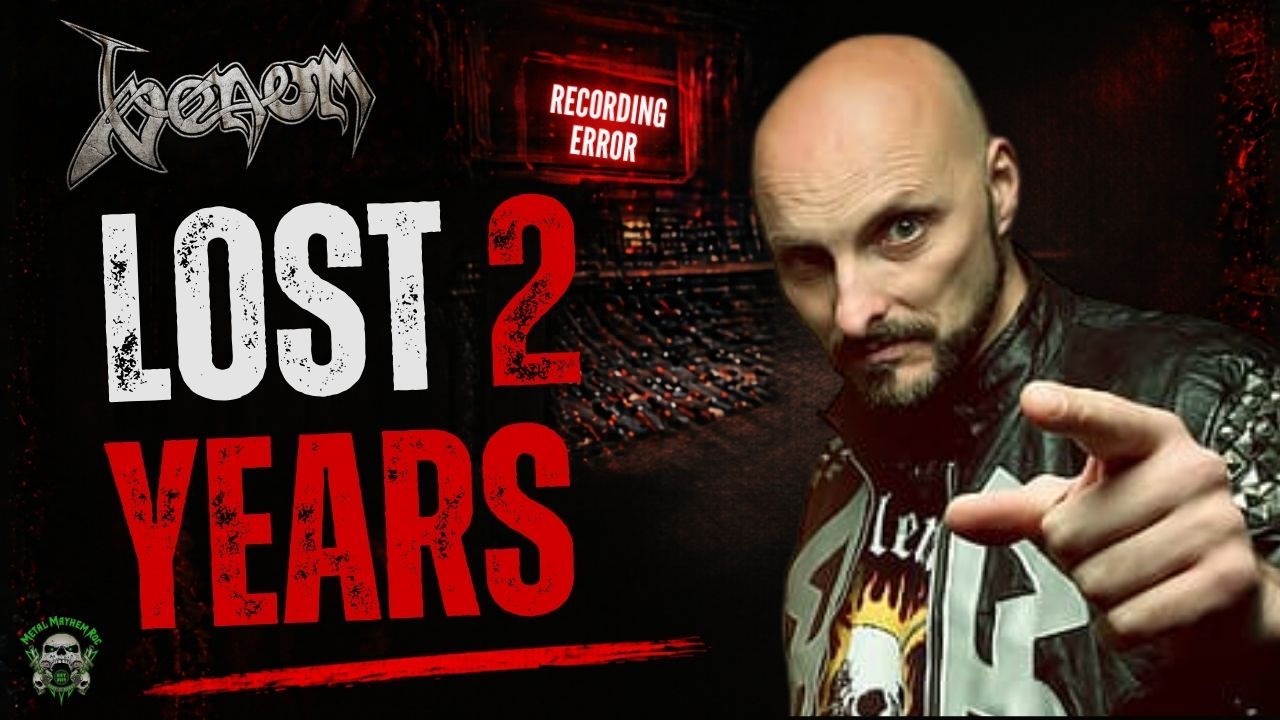
The road to Into Oblivion wasn’t just long, it was reset entirely. In conversation with Metal Mayhem ROC, Venom guitarist Stuart “Rage” Dixon detailed how a technical failure during recording forced the band to scrap a major portion of the album and start over from scratch.
The album features the long-standing lineup of Cronos, bass and vocals and founding member, Rage on guitar, and Dante on drums, a trio that continues to define the band’s modern era as outlined in the official label press release.
That setback didn’t stall the record, it reshaped it.
With Into Oblivion out now, the result is an album that leans further into dynamics, experimentation, and a more instinctive creative process, one that reflects both circumstance and evolution inside the band.
The Catalyst
The turning point for Into Oblivion came during what should have been the final stages of recording. Instead, a flawed drum microphone introduced intermittent issues that could not be corrected.
Rather than patch the recordings, the band made a decisive call.
They scrapped everything.
That decision erased roughly two years of work, but it also created an opportunity. Returning to the demos allowed the band to revisit earlier ideas without attachment, restoring elements that had previously been cut and expanding the material in ways that were not originally planned.
What followed was not a controlled rewrite, it was a natural progression. Without a rigid roadmap, the songs began to evolve on their own terms, resulting in what Dixon describes as a more progressive album. Not by design, but by process.
The Creative Process
The way Into Oblivion was built stands in contrast to modern recording conventions. Much of the album’s early writing happened in isolation during lockdown, when band members were forced to work independently rather than in a shared space.
That separation had a direct impact on the music.
Without the usual group filter, ideas developed more freely. Individual experimentation, particularly through newly upgraded home studios, introduced textures and approaches that may not have surfaced in a traditional writing environment.
When the band finally regrouped, they carried that independence forward.
Recording sessions avoided strict structure. There was no click track guiding the tempo, allowing songs to breathe and shift naturally. Faster sections pushed forward, slower passages pulled back, creating a sense of movement that mirrors a live performance rather than a controlled studio product.
The production followed the same philosophy. No digital shortcuts, no programmed elements. Amplifiers, instruments, and performances were captured as they were played, reinforcing the organic feel that defines the album.
Sound, Intent, or Message
If Into Oblivion pushes into new territory, it does so without losing its foundation.
Dixon points to the band’s identity as something anchored by Cronos’s voice, a constant that allows the surrounding music to evolve without disconnecting from what listeners recognize as Venom. That stability creates space to take risks.
Those risks show up in the structure of the songs. Tracks move beyond straightforward speed, incorporating shifts in pacing, extended arrangements, and moments of contrast. Dixon’s emphasis on melody plays a key role here, shaping how heavier passages resolve and giving the material a broader emotional range.
The influences behind that approach extend well beyond metal.
Early in his development, Dixon and his peers were drawn to albums based on visual impact as much as sound. Record covers led them to bands they did not fully understand at first, particularly Southern rock acts whose imagery suggested something heavier than what they initially heard. Over time, that disconnect became valuable, introducing a deeper appreciation for songwriting and structure.
That mindset carries into more unexpected influences as well. Songwriting is treated less as a purely musical exercise and more as a visual one, constructing songs like scenes, building tension and atmosphere as they unfold.
Touring / What’s Next
With Into Oblivion out now, the focus shifts to bringing the material to the stage.
The band is preparing to return to live performance through a series of festival appearances beginning in June. A core group of songs from the new album is already identified as part of the set, with an emphasis on balancing newer material with established tracks in a way that maintains flow and energy.
Beyond Europe, there is a clear intention to expand live presence. Logistics have historically limited consistent touring in North America, but ongoing efforts, including potential long term visa solutions, could change that.
The goal is straightforward, reestablish the band in territories where they have appeared sporadically but have not fully developed a sustained presence.
Why This Interview Matters
What emerges from this conversation is not just an album cycle update, but a snapshot of a band operating with renewed clarity.
Seventeen years into his tenure, Dixon describes his role within Venom as natural, no longer something to adapt to, but something fully integrated. That comfort level is reflected in the music, where experimentation is no longer tentative but intentional.
Into Oblivion does not present itself as a reinvention. Instead, it reflects a band willing to evolve within its own identity, drawing from a wide range of influences, trusting instinct over formula, and turning setbacks into forward motion.
Subscribe to Metal Mayhem ROC on YouTube
https://www.youtube.com/@metalmayhemroc1851
Watch the Full Interview
GET SPECIAL MMROC SHOW UPDATES!
Become a part of a community of fellow metal heads who get updated on special episodes, interviews and and exclusive metal news.
We hate SPAM. We will never sell your information, for any reason.


